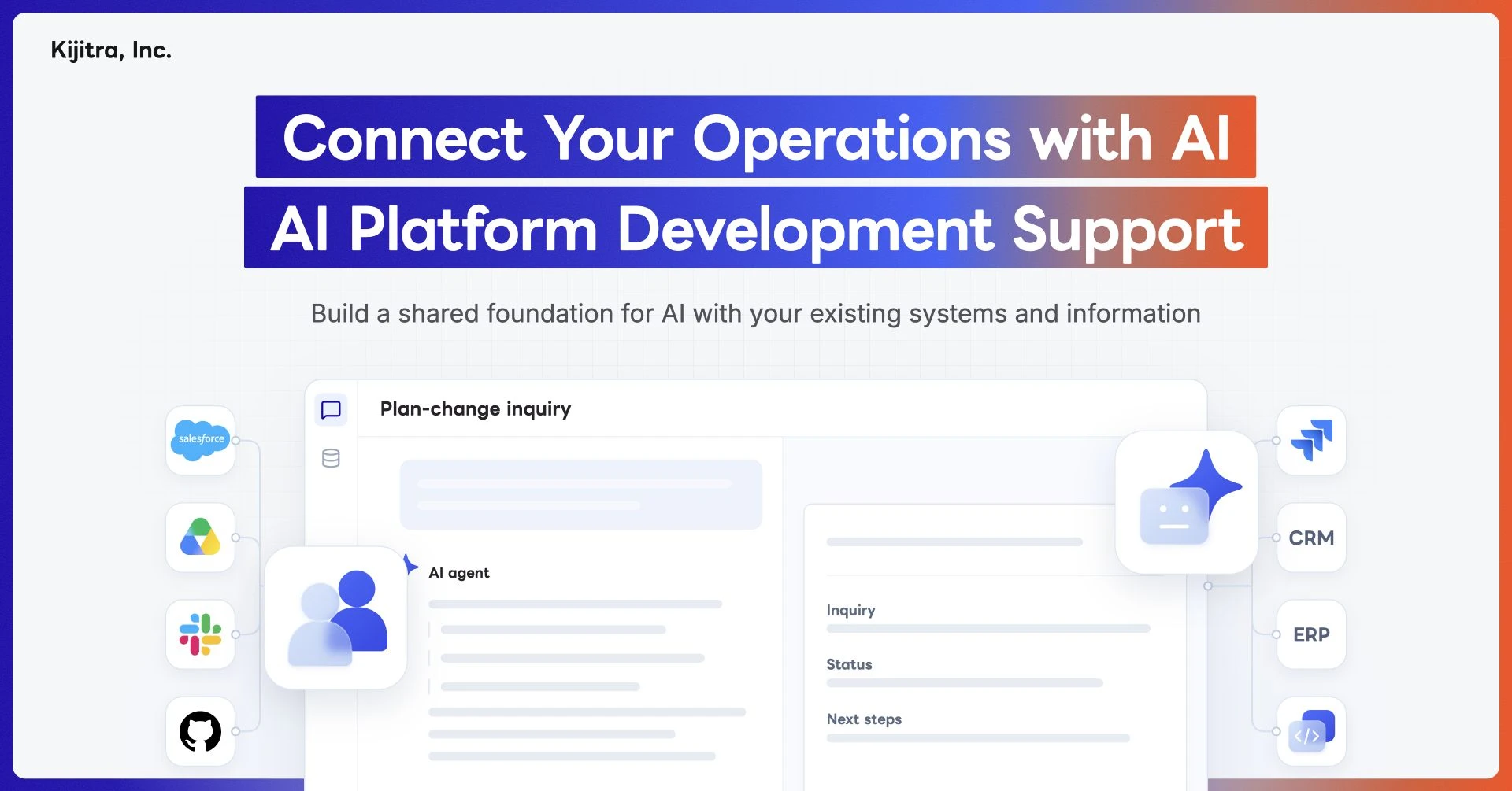
Kijitra, Inc. (headquartered in Fukuoka City, Fukuoka Prefecture, Japan; representative: Taiki Ikeda) is launching AI Platform Development Support. The service uses information from a company's existing business systems, SaaS, and internal tools to create an environment where people and AI can work from shared information and procedures.
We support the process from understanding business operations and organizing information to designing the information foundation that AI draws on and building a prototype. Working with each company, we identify which parts of its current operations can be delegated to AI, from customer inquiries and document preparation to product development, and help put those workflows into practice.
Service details (Japanese): https://kijitra.com/business/ai-platform/
Why we are launching this service
To use AI agents in business operations, companies need an environment suited to the way they work. When each team member chooses their own tools, prepares their own materials, and refines their own prompts, both the volume and quality of the output depend on that individual's knowledge and experience.
At Kijitra, we use AI in our own product development and internal operations, and have worked to create environments where AI agents can operate more efficiently. Drawing on that experience, we help companies build an AI environment around their workflows and existing systems, so that AI becomes part of how the whole organization works.
Building an AI platform around existing systems
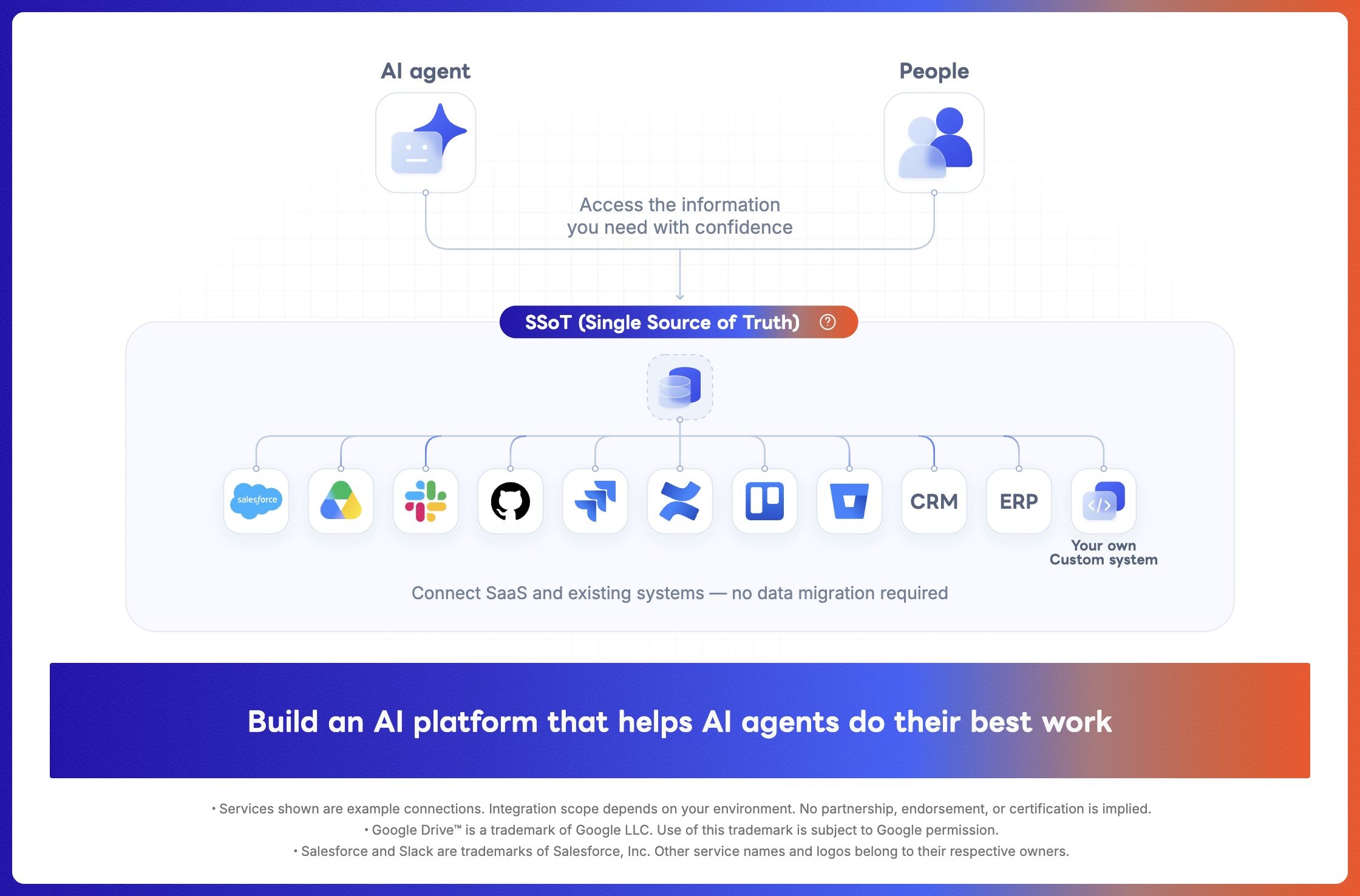
We begin by discussing each company's current operations, then design which information sources AI should consult, which tools it should use, and which procedures it should follow.
First, we establish rules for identifying the authoritative sources of customer information, internal manuals, past support records, and other information. Creating a single source of truth (SSoT), shared by people and AI, reduces the risk of using inaccurate documents or outdated information.
We then turn work that previously required people to issue instructions at every step into workflows that AI can execute autonomously. We define the information to consult, the steps to follow, and the conditions for completion, including a mechanism for requesting approval whenever human judgment is needed.
How this differs from adopting individual AI tools
The AI platform built through this service connects isolated uses of AI for individual tasks into workflows that carry an entire process forward. We define these workflows as operations that can maintain a consistent standard of quality even when the person responsible changes, without relying on each individual's skills.
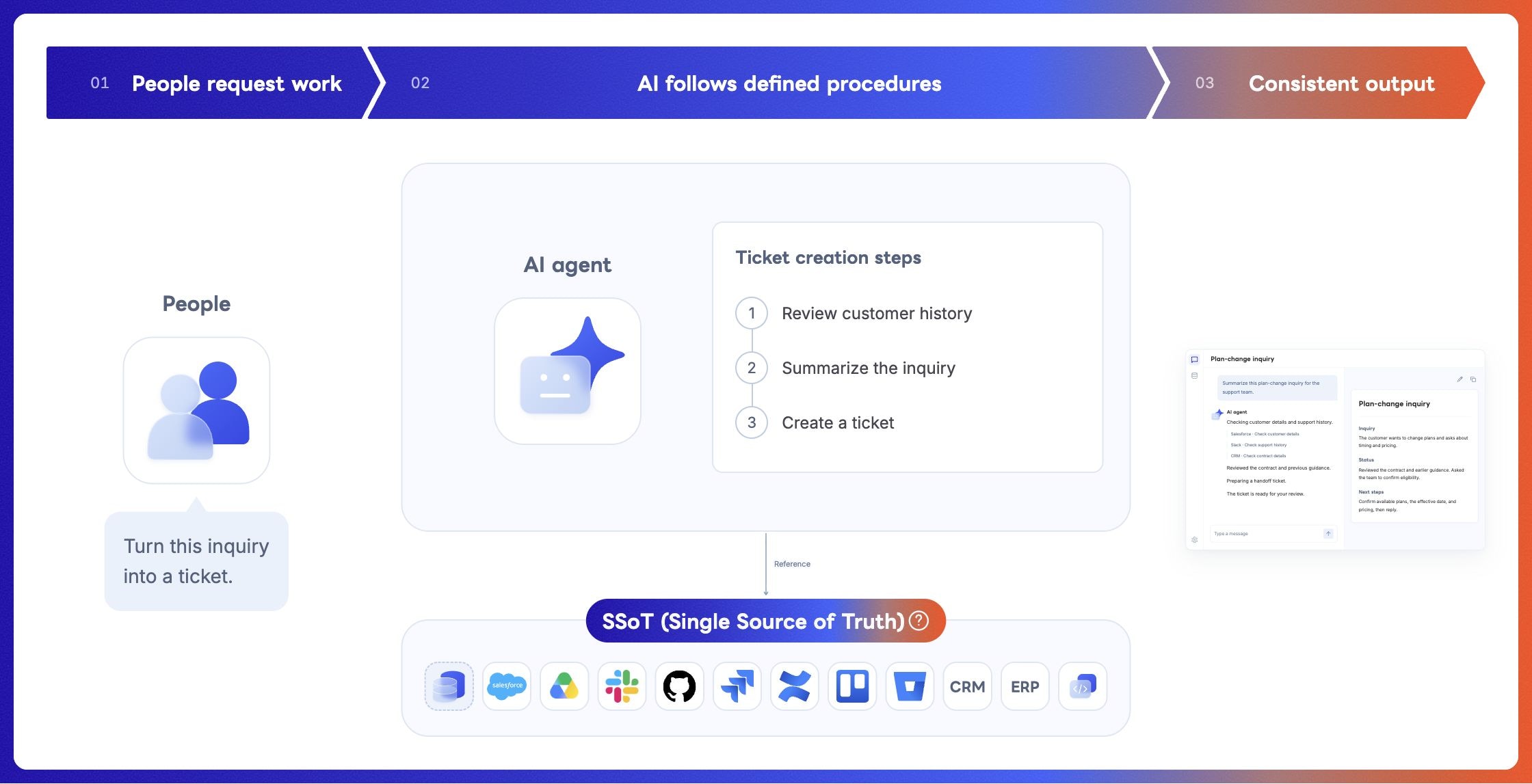
An AI platform provides a foundation for improving and automating multiple operations at once. Its scope extends beyond the local efficiency gains of individual AI tools to changing how an entire organization works. It provides a foundation for reshaping the organization for the AI era.
| Using AI tools individually | Kijitra's AI Platform Development Support | |
|---|---|---|
| How work is delegated to AI | Individuals request separate tasks, such as summarizing information or writing text | Build operations that AI can handle from checking information through execution |
| Information provided to AI | A team member finds the necessary documents and supplies them to the tool | Connections to internal information sources allow AI to consult authoritative information on its own |
| Output quality | Quality depends on the documents selected and the instructions given | Shared information sources, procedures, and review criteria reduce omissions and variation in quality |
Example use cases
The following are examples of workflows that can be built and tested using an AI platform. The actual scope is designed around each company's challenges and the operations it wants to improve.
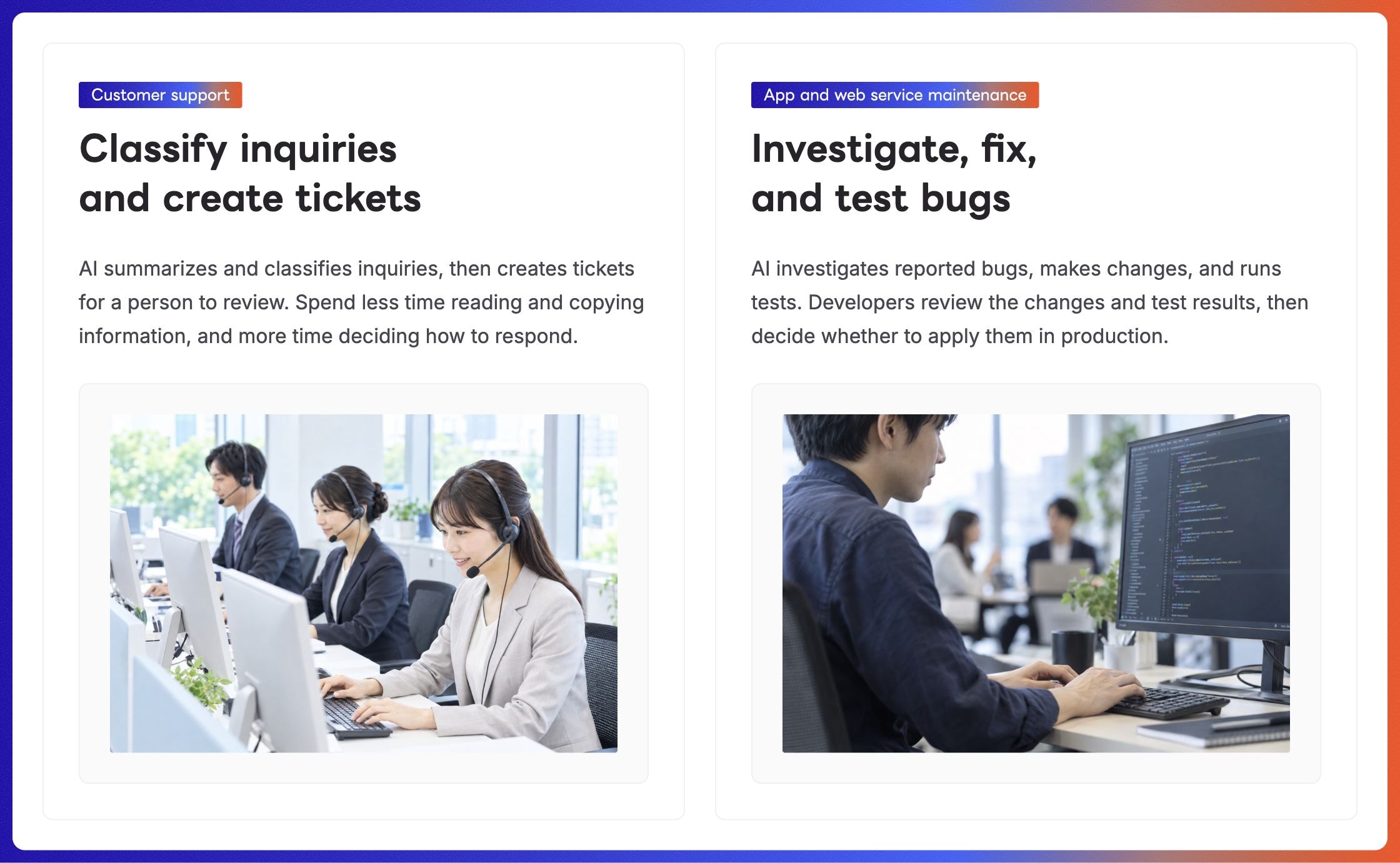
Automatically classify customer inquiries and create tickets
AI summarizes and classifies customer inquiries, extracting the information needed to respond. It identifies missing information and points that need clarification so the person responsible can get started promptly.
Connecting the workflow to past support records and operational manuals allows it to expand gradually to suggest related cases and possible responses. This reduces the time spent reading messages, searching for information, and copying it between systems, leaving more time to decide what action to take. The person responsible reviews the results.
Automate bug investigation, fixes, and testing
For mobile app and web service development and operations, we build workflows in which a detected bug or a request for a fix triggers AI to investigate the cause, make changes, and run tests automatically.
We give AI access to the company's code and development rules, and set up an environment where it can run and verify the changes. People review the changes and test results, then decide whether to apply them. By delegating maintenance work to AI, we aim to help development teams focus on new features, improvements to the user experience, and testing business hypotheses.
Applications across other industries and operations
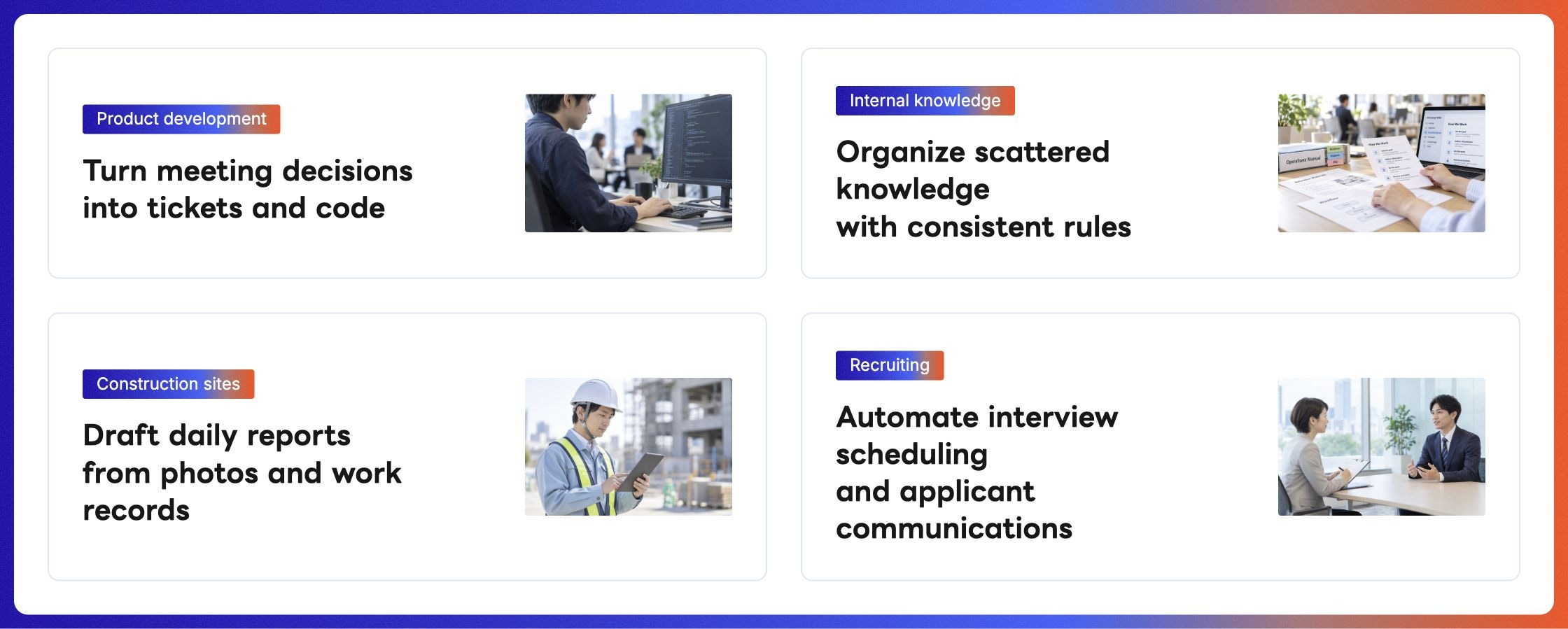
- Organize internal knowledge and automatically create proposals.
- Analyze sales conversations with AI and provide sales coaching.
- Automate article outlining and writing based on interview material.
- Organize scattered internal knowledge according to defined rules.
- Draft daily construction reports from site photos and work records.
- Automate applicant communications, from interview scheduling to follow-up messages.
From understanding operations to a prototype in about one month
The basic plan aims to take approximately one month, from investigating the target operations and information to building a prototype. We first discuss workflows, existing systems, internal documents, and the experience and accumulated knowledge of the people doing the work. We then design the information foundation and test it against actual workflows.
Experience gained through our own product development
At Kijitra, we have rebuilt our own product development workflows around AI and continue to update how we work across planning, implementation, review, and measuring results. As AI advances, we adapt our day-to-day operations and, at times, even how team members communicate with each other.
Through this service, we apply what we have learned in practice to each company's operations. Our team members bring experience in launching businesses and developing products at startups. They clarify operational challenges, build prototypes quickly, and expand the scope of implementation as they verify its value in real work.
We want to create a world where people can keep creating value by focusing on better businesses and products, free from the pressure of repetitive work. As users who continually improve these systems ourselves, we develop workflows that people can keep using in their day-to-day operations.
Contact us
You are welcome to talk with us even if you are not yet sure which operations to start with. Tell us about the work you would like to delegate to AI and the systems you currently use.
Inquiries (Japanese): https://kijitra.com/business/ai-platform/#contact